

Three institutes, two days, countless ideas: On 1 and 2 October the LCI Retreat in Bad Segeberg brought together researchers and staff from the Leibniz Institute of Virology (LIV), the Research Centre Borstel (FZB) and the Bernhard Nocht Institute for Tropical Medicine (BNITM) to explore what can emerge when different expertise, perspectives and ideas meet.
Over two days, participants discussed current challenges in infection biology, strengthened existing networks and explored new opportunities for joint research projects. Beyond research, the retreat also provided an opportunity to exchange experiences and best practices in administration, data management, early-career scientist training and communication.
The challenges facing research are becoming increasingly complex, requiring researchers and supporting staff to pool expertise and share approaches across disciplines and institutions.
The Leibniz Center Infection (LCI) was created with precisely this idea in mind. Founded in 2005, the Leibniz Center Infection is a strategic alliance of three Leibniz research institutes in Northern Germany dedicated to research on highly relevant infectious diseases. More than 20 years later, the need to connect expertise across institutional and disciplinary boundaries is as relevant as ever.
New models and artificial intelligence are transforming research, infections can have long-term consequences, and prevention is an important goal in global health. Against this backdrop, four scientific topics took centre stage during this year’s retreat: post-infectious diseases, artificial intelligence, organoid research and prevention.
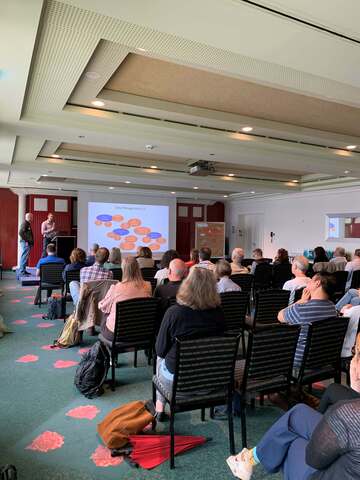
Artificial intelligence is emerging as a major challenge and opportunity across scientific disciplines. In his impulse talk, Prof. Thomas Otto from the BNITM explored the opportunities and challenges AI presents for scientific research and encouraged participants to consider how this rapidly developing technologies could shape research in the future.
Post-infectious diseases have recently gained widespread attention, not least because of Long COVID. Yet, as Prof. Gülsah. Gabriel from the LIV pointed out in her impulse talk, the phenomenon itself is not new. She highlighted the role infectious diseases can play in contributing to non-communicable and chronic conditions, with consequences that can extend beyond individual patients and place an additional burden on healthcare systems. Her presentation provided a starting point for further discussion, with participants invited to explore the topic in greater depth during a focus group in the subsequent World Café.
Prof. Iris. Bruchhaus from the BNITM turned the focus to organoid research, highlighting the potential of these advanced model systems to study complex processes in infection biology that cannot always be captured by conventional cell culture or monolayer models. But advanced models also come with new demands: working with organoids requires specialised expertise and considerable technical know-how. Sharing this expertise and exchanging best practices can therefore be an important way for LCI partners to learn from each other and further strengthen their research capabilities.
In his impulse talk, Prof. Markus Weckmann from the FZB talked about the challenges of prevention research. He challenged participants to rethink how prevention is measured and valued. He highlighted the need for a broader One Health perspective that captures the benefits of prevention across human, animal and environmental health, while strengthening cross-sectoral collaboration to make the impact of preventive measures more visible.
The impulse talks opened the door to a broader exchange. During the World Café, participants explored the four scientific topics in smaller groups, bringing together different perspectives, questions and experiences. The results were presented on the following day.
The discussions extended beyond the scientific topics. Participants could also exchange ideas on data management and IT, infrastructure and technology platforms, PhD and postdoctoral training, administration and science management, as well as public relations and communication.
The LCI Retreat showed that bringing together different areas of expertise is not only about sharing knowledge. It is about creating connections that can turn individual ideas into joint approaches and, ultimately, into new opportunities for research and collaboration.
